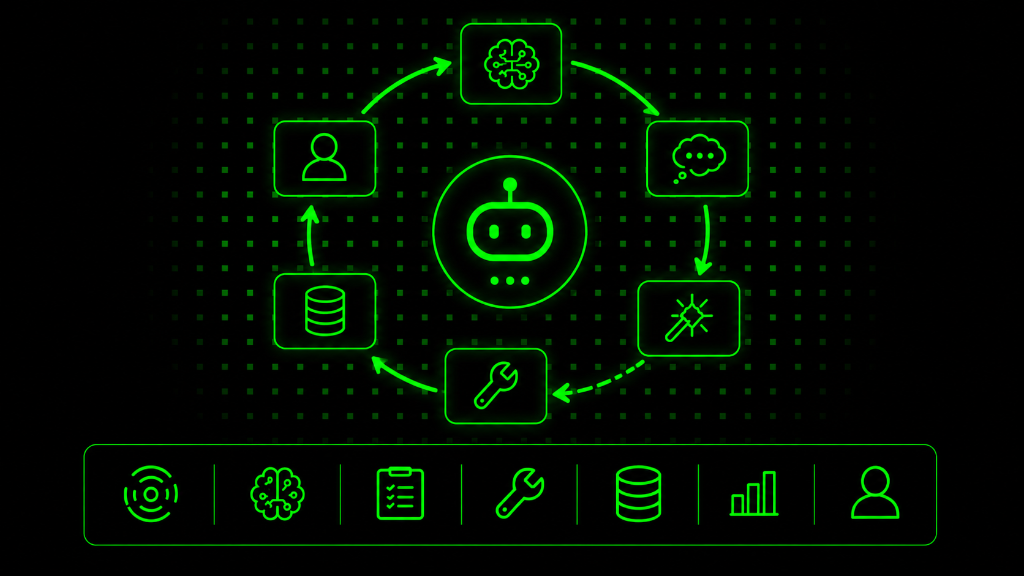
The Agent Loop: How AI Thinks, Decides & Acts
The complete visual guide to autonomous AI architecture. Covers the 5-phase agent loop, core components, ReAct & multi-agent patterns, real-world examples from Claude Code to ml-intern, stopping conditions, and how to build your first agent loop.
1. What Is the Agent Loop?
An Agent Loop is the continuous iterative cycle through which autonomous AI systems operate. Unlike a chatbot (one input → one output → stop), an agent runs in a persistent loop: it perceives the situation, reasons about the best next step, acts on that decision, observes the result, learns from the outcome, and repeats — until the goal is achieved or a stop condition is met.
Chatbot vs Agent: The Fundamental Difference
| CHATBOT (Single Pass) | AGENT (Iterative Loop) | |
|---|---|---|
| Flow | User → LLM → Response → STOP | User → LLM → Tool → Result → LLM → … → Done |
| Pattern | One input, one output | Reason → Act → Observe → REPEAT |
| Use case | Q&A, writing, summarization | Research, coding, automation, multi-step tasks |
The pseudocode that powers every agent loop in existence is remarkably simple:
while not done:
    response = call_llm(messages)
    if response has tool_calls:
        execute them, append results, loop again
    else:
        done = True  # task complete
If the response contains tool_calls, execute them, append the results, and loop again. If not, the task is complete. This simple pattern enables agents to solve problems that require multiple steps, multiple tools, and multiple rounds of reasoning.
2. The 5-Phase Agent Loop
Every agent loop follows five phases, regardless of the framework:
| Phase | What Happens | Example |
|---|---|---|
| 1. Perceive | Captures input — text, images, voice, API data, sensor readings | User asks: 'Find the most cited AI paper from 2026' |
| 2. Reason | LLM analyzes context, determines which tool to call and with what parameters | Agent reasons: 'I need to search academic papers — use search API' |
| 3. Act | Executes the chosen tool — API call, code execution, file operation, web search | Calls search API with query 'most cited AI paper 2026' |
| 4. Observe | Processes the tool's response, evaluates results, checks if goal is met | Receives 15 papers. Identifies top result with 340 citations. |
| 5. Learn | Updates context, refines approach, decides whether to loop again or stop | Needs full abstract — loops back to Act: calls document retrieval tool |
The LLM sits at the core, orchestrating all five phases in each iteration.
3. Core Components of an Agent Loop
| Component | Role |
|---|---|
| Orchestrator | The control center — manages the loop, routes between phases, handles errors, enforces stopping conditions (max iterations, token budget, goal achieved) |
| Context Engine | Manages the conversation history, tool results, and accumulated knowledge across iterations. Handles context window limits via compaction and summarization. |
| Memory System | Short-term (current session messages), long-term (persistent knowledge across sessions), and working memory (current task state). Critical for multi-session agents. |
| Reasoning Engine | The LLM itself — processes context, decides actions, generates responses. Quality depends on model capability (Opus > Sonnet > Haiku for complexity). |
| Tool Registry | Available tools the agent can call: APIs, code execution, file operations, web search, databases. Defined with name, description, and JSON Schema parameters. |
| Feedback Loop | Evaluates outcomes, assesses performance, and adjusts future behavior. Includes success/failure detection, reward signals, and self-correction mechanisms. |
| Safety Layer | Guardrails, permission boundaries, rate limits, and human-in-the-loop checkpoints. Prevents runaway loops, excessive spending, and unauthorized actions. |
4. Agent Loop Patterns
Pattern 1: ReAct (Reason + Act)
The most common pattern. The agent alternates between reasoning (thinking about what to do) and acting (executing a tool). Each cycle: Thought → Action → Observation. Used by Claude Code, ChatGPT, and most production agents. Simple, reliable, and well-understood.
Pattern 2: Plan-Execute
The agent first creates a complete plan (list of steps), then executes each step sequentially. Better for complex tasks with known structure. Risk: plan may become stale if early steps produce unexpected results.
Pattern 3: Multi-Agent Orchestration
A supervisor agent delegates subtasks to specialized agents running their own loops. The supervisor coordinates results, handles failures, and synthesizes the final output. Used for complex tasks like full-stack development (frontend agent + backend agent + test agent running in parallel).
Pattern 4: Recursive Self-Improvement
The agent evaluates its own output, identifies weaknesses, and re-runs with improvements. Hermes Agent uses this pattern — after completing a task, it synthesizes the experience into a permanent skill for next time.
5. Real-World Agent Loop Examples
| Agent | Loop Pattern | Max Iterations | Tools Used |
|---|---|---|---|
| Claude Code | ReAct with Extended Thinking | Unbounded (token budget) | bash, file edit, file create, web search |
| OpenAI Codex CLI | ReAct with sandbox | Per-turn (user returns control) | code execution, file ops, shell |
| Hermes Agent | ReAct + Self-Improvement | 300 iterations per session | MCP servers, shell, browser, cron |
| OpenClaw | ReAct + Dreaming | Continuous (always-on) | 25+ messaging channels, browser, APIs |
| ml-intern | Plan-Execute + Iteration | 300 iterations (smolagents) | arXiv, HF Hub, GPU training, eval |
| Devin / Cursor Agent | Plan-Execute | Task-bounded | code, terminal, browser, git |
6. When Does the Loop Stop?
| Stop Condition | How It Works |
|---|---|
| Goal Achieved | The agent determines its task is complete — generates a final response without tool calls |
| Max Iterations | Hard limit on loop cycles (e.g., 300 for ml-intern). Prevents infinite loops. |
| Token Budget | Total tokens consumed hits a cap. Claude Code uses this — prevents runaway costs. |
| Human Intervention | Agent requests approval before continuing. Used for high-risk actions. |
| Error Threshold | Too many consecutive failures. Agent gives up and reports what went wrong. |
| Time Limit | Wall-clock time exceeded. PostTrainBench uses 10-hour limit. |
Key Insight: The most common production failure is infinite loops — agents that keep calling tools without making progress. Always implement both max iteration AND token budget limits. Monitor cost per session in production.
7. Building Your First Agent Loop
The complete agent loop in pseudocode is surprisingly simple. Here's what every agent — from Claude Code to Hermes to ml-intern — runs under the hood:
# The Universal Agent Loop
messages = [system_prompt, user_input]

while not done:
    response = call_llm(messages)

    if response has tool_calls:
        for tool in response.tool_calls:
            result = execute_tool(tool.name, tool.args)
            messages.append(tool_result(result))
    else:
        done = True
        return response.text
That's it. Every agent framework — LangChain, smolagents, CrewAI, AutoGen — is a variation of this pattern. The differences are in how they handle memory, tool routing, error recovery, multi-agent coordination, and stopping conditions. But the core loop is always: call LLM → if tools needed, execute and loop → if no tools, return result.
8. GCC Business Applications
| Industry | Agent Loop Use Case | Business Impact |
|---|---|---|
| E-Commerce | Product research agent loops across supplier APIs, price comparisons, and inventory checks | 80% reduction in manual research time |
| Customer Support | WhatsApp agent loops through CRM, order system, FAQ database before responding | 24/7 bilingual Arabic/English support |
| Marketing | Content creation loop: research → draft → SEO optimize → localize to Arabic | 5x content output from same team |
| Legal | Contract review loop: read → flag clauses → check regulations → summarize risk | Hours reduced to minutes |
| Finance | Report generation loop: query data → analyze → build charts → format → export | Weekly reports automated |
| Real Estate | Lead qualification loop: enrich data → score → personalize → route to agent | 3x qualified pipeline |
Need help building AI agent loops for your GCC business? Conneqt designs and deploys agent systems for Saudi Arabia and GCC companies. Visit conneqtme.com or contact us for a free AI audit.
Book a Free AI Audit
We'll build your first AI agent and identify the top 3 automation opportunities in 2 weeks.
Contact Us →