AI News KSA
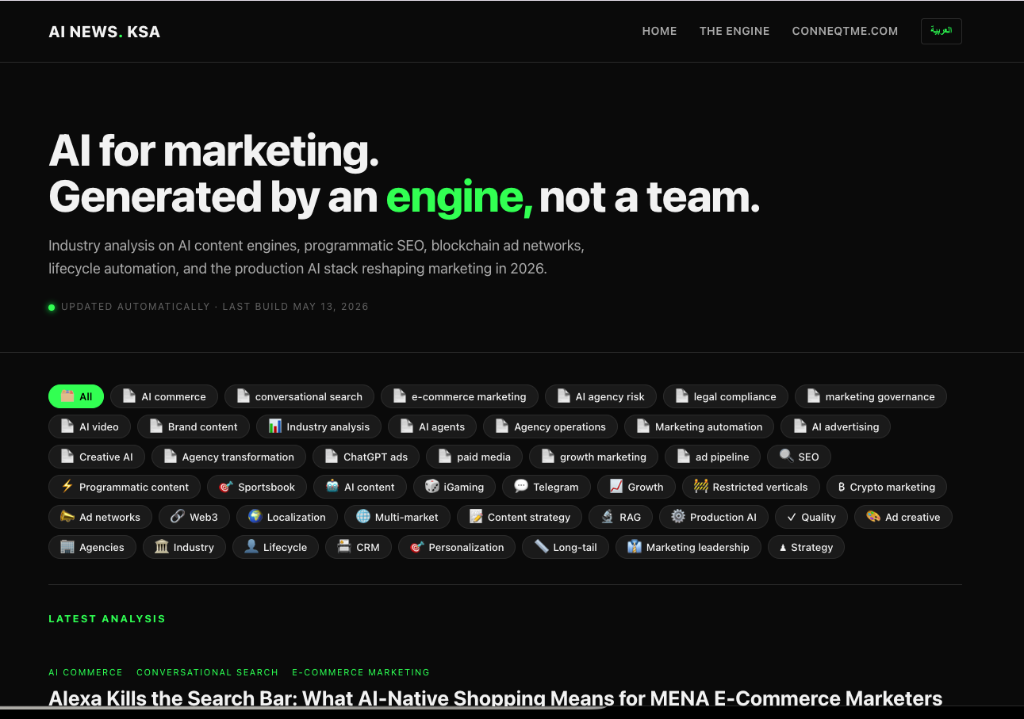
Most AI content vendors sell the product without using it. We took the opposite approach. AI News KSA is a live, autonomous deployment of the engine Conneqt builds for operator clients — running on its own data, in two languages, with no human in the publishing loop.
This case study exists for one reason: to make the architecture concrete. Pitch decks describe engines. Working systems prove them.
For reference: producing one published article through a human writer costs $40–$100. The engine ships at roughly 1/200th of that cost while maintaining higher accuracy through the RAG verification layer than most editorial pipelines achieve.
AI News KSA is an industry analysis publication on AI for marketing and growth, targeting MENA marketing leaders. Every article is generated, fact-checked, and published autonomously every 6 hours. The seed corpus of 10 articles was hand-written by Conneqt to define the editorial voice; every article from May 12, 2026 onward was produced by the engine.
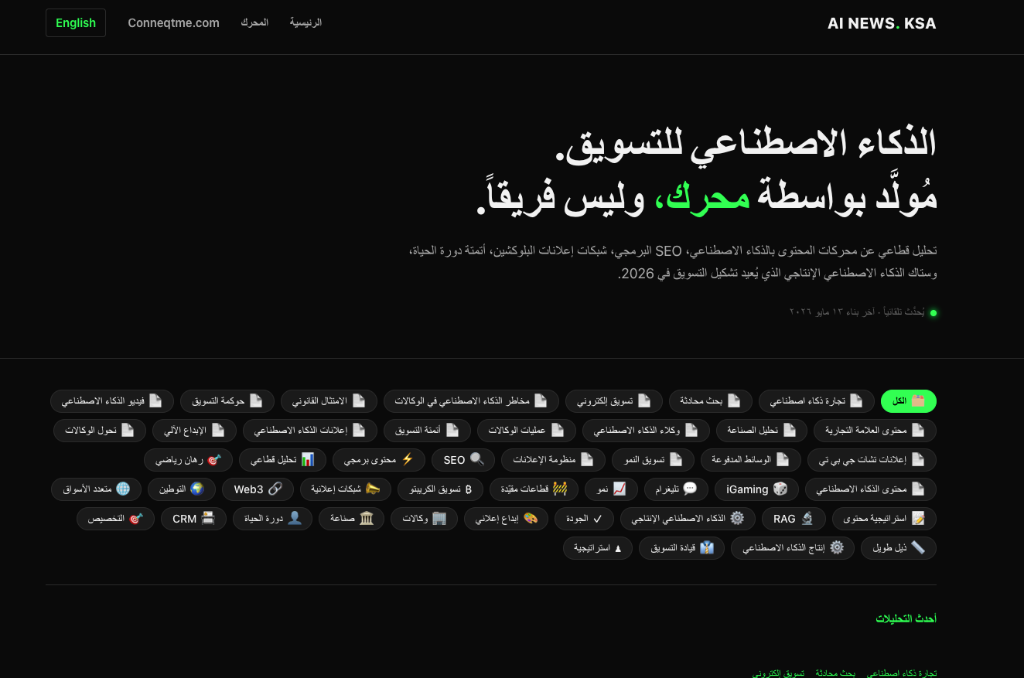
The same publication exists in native Modern Standard Arabic at /ar/. Not translated — generated independently in Arabic from the same source briefs. The voice file for Arabic and the voice file for English are different system prompts, refined separately.
The engine polls eleven RSS sources every six hours: TechCrunch AI, The Verge, VentureBeat AI, Wired AI, Ars Technica AI, MIT Technology Review, Hugging Face, Google AI, Marketing AI Institute, One Useful Thing, and Latent Space. Combined: 50–80 fresh AI news items per cycle.
Claude Sonnet 4.6 selects up to two items as most relevant for MENA marketing leaders. The selection prompt passes context about every article published in the last 30 days so the model avoids duplicate coverage. Each story becomes a structured brief: angle, target market, tags, proposed headline in both languages.
Versioned system prompts encode editorial tone — analytical not promotional, skeptical of vendor claims, specific examples over abstract claims, MENA framing where natural. Separate prompts for English and Arabic, refined iteratively against output samples.
Two parallel Claude calls per story — one English, one native Arabic. Each is roughly 600–800 words, structured with paragraph and subheading tags only, generated via Claude's tool-use mode for guaranteed valid output. The Arabic generation is not translation — it's a separate writing pass against the same source material with its own voice prompt.
Each output runs through a verification pass that retrieves the source article and asks Claude: does this output match the source on statistics, names, dates, companies, and quoted material? If anything fails, the article is rejected and the next candidate runs. Hallucinations are caught at this layer ~25–35% of the time, which is the system working as designed.
Approved articles get schema.org Article markup, hreflang tags for bilingual indexing, programmatic internal linking to related pieces, and automatic sitemap regeneration. Each piece is structured for search engines to index correctly without any manual intervention.
Static HTML pushed via git commit. Cloudflare Pages auto-rebuilds in under sixty seconds. CDN-distributed globally.
Engagement data flows through Google Analytics 4. Read time, scroll depth, and return visits inform future brief selection — winning topic angles get more weight, losing patterns retire.
The architecture above is the spine. For each client deployment, four things get retrained:
For a sportsbook: Sportradar or Stats Perform feeds. For crypto: on-chain events + market data. For e-commerce: product catalog updates and inventory deltas. The ingest layer adapts to whatever structured data the operator owns.
System prompts rebuilt to match the client's editorial conventions — tone, vocabulary, banned phrases, regulatory tone per jurisdiction. This is the most time-intensive part of the pilot and where Conneqt's domain knowledge accumulates.
Sportsbook: match previews, post-match recaps, push notifications, SEO landing pages. Crypto: Telegram channel posts, X threads, ad creative variants. E-commerce: product descriptions, category pages, blog content tied to inventory movements.
Where content goes: client's CMS via API, push services, social schedulers, ad networks, or Telegram bots — depending on the operator's existing stack.
Everything else — the orchestration, fact-check architecture, multi-language fan-out, autonomous publishing — stays the same. That's what makes the engine deployable in six weeks instead of six months.
| Layer | Technology |
|---|---|
| LLM — brief selection | Claude Sonnet 4.6 |
| LLM — generation | Claude Sonnet 4.6 (parallel EN + AR calls) |
| LLM — fact-check | Claude + RAG (source retrieval + verification pass) |
| Ingest | 11 RSS feeds · 6-hour polling cadence |
| Content format | Static HTML · schema.org Article · hreflang |
| Publishing | Git commit → Cloudflare Pages → CDN |
| SEO | Programmatic internal linking · auto sitemap regeneration |
| Analytics | Google Analytics 4 · feedback loop to brief selection |
| Infrastructure | Cloudflare Workers · GitHub Actions · Free tier hosting |
| Languages | English (EN) + Modern Standard Arabic (AR) — independently generated |
For operators reading this
If you operate in sportsbook, crypto, e-commerce, or any vertical where structured data exists and content velocity is a competitive bottleneck, this engine deploys to your stack on a six-week fixed-fee pilot. We ingest your data, build the voice layer with your editorial team, ship the first batch of generated content for human review, and ramp human-in-loop down as the validators prove themselves.
The site you're reading right now is what production AI content looks like. Same architecture, retrained for your data, shipped in your markets, in your languages, at your cadence.